Five Great TV Dramas To Watch This Summer

Here Emma D picks five of her favourite TV Dramas that she recommends you check out

Bittersweet Mondays: Weekly Webcomic

Confab presents the brand new Bittersweet Comics debut with the first of a weekly web-comic series.

Game Review: Serious Sam: The Second Encounter HD

Sam returns in a remake of the 2002 classic sequel, how does it stand up?

The Sexism of Horror Video Games

The history of sexism in video games is almost as old as games themselves, Emma D discusses the underlying sexism of the horror genre

Film Review: The Amazing Spider-Man

Spidey's latest outing hits the cinemas, does this reboot make a name for itself or is it just another cheap Hollywood cash-in?

Volunteer: A Career for the Unemployed

With high rates of unemployment across the globe, Charlotte explains why now is a great time for the jobless to volunteer!

Overrated: The Legend of Zelda Skyward Sword

Claimed by many critics as 'The Best Zelda Ever!'. Long time Zelda fan Emma D argues why it didn't live up to the hype.

Showing posts with label Game Review. Show all posts

Saturday, 28 July 2012

Game/Tech Review: Nintendo 3DS XL System

It's certainly bigger, but is it actually better?


Way back in March of 2011, when the 2012 Olympics were still far enough down the line that the horrendous logo wasn't plastered on everything under the sun, Nintendo released their next generation of handheld video game consoles, the Nintendo 3DS. Many eager gamers lined up for midnight launches across the country to get their hands on the new fancy 'glasses-less 3D' system. Despite the heavy anticipation and hype surrounding the system, the 3DS saw fairly lacklustre sales in its opening months, perhaps it was the wallet-devouring launch price of £220-£230, maybe it was the lack of must-have AAA game titles or it could have been the lack in significant aesthetics and name from Nintendo's previous DS handheld models, the Nintendo DS, DS Lite and DSi appearing to be just another revision rather than a fully new, more powerful system. Whatever the cause it prompted Nintendo to act quickly and slash the retail price of the 3DS to a far more acceptable £149.99 in stores, this new price cut and a handful of new must-have titles such as the Zelda: Ocarina of Time 3DS remake inflicted a huge and healthy spike in 3DS console sales.

Fast forward to now, the end of July 2012 and Nintendo have released a hardware revision of the 3DS, just 18 months after the 3DS launch. This revision, the 3DS XL's main selling point it commands is the 90% larger screens, 'the largest screens ever on a Nintendo handheld' the adverts boast. The top screen stretches 4.88 inches diagonally and the bottom touch screen at 4.18 inches. The original 3DS displays came in at 3.53" and 3.02" respectively.


Having played a few different games on the top screen, I've already begun to appreciate the larger, less reflective screen, 3DS games look great on it and the 3D works even better than before, with a larger 'viewing window' thanks to the screen size boost, this 'sweet spot' for the 3D is much more accessible. I often found myself holding the original 3DS closer than I would like to see more of the detail or get the best out of the 3D. Thankfully the 3DS XL can be played from a more comfortable distance without feeling the need to bring the system closer.
Up close however the 3DS XL does highlight the fairly low resolution (400x240 or 800x240 with 3D) of the top screen. If you look closely enough the pixels are far more visible to the human eye than they were on the 3DS. As Nintendo opted to keep the screen resolution the same some games can appear slightly more pixelated or 'jaggy' but I never found it to detract from my gameplay sessions, in fact, I found myself somewhat more immersed in games than I had been with the original 3DS.

Alongside the behemoth sized screens Nintendo has given the main body a slight makeover, gone are the fingerprint magnet glossy coats and instead, we're treated to a more premium and in my opinion, more attractive dual matte finish in black and either metallic Blue, Red or Silver. The stylus (which is now one solid body rather than the telescopic 3DS stylus) has been re-positioned to the right-hand side, in a move mirroring the DS to DS Lite stylus relocation, which is far more accessible during gameplay. Scrambling to find the stylus on the back of the original 3DS during gameplay was either hectic or game-pausing, the experience is far more seamless now.

The face buttons have seen some minor improvements, which now feel more clicky and as a result ever so slightly more responsive. The D-pad has received a minor size increase and due to the larger 3DS body, is far more practical to use in games, the original 3DS' size and shape made using the D-pad cumbersome and even cramp-inducing, so far I've had no complaints about using the D-pad on the 3DS XL. This brings me to the overall ergonomics of the unit, the console feels much sleeker and more comfortable to hold than its predecessor, which had protruding square edges and corners which I found didn't get on well with my gaming palms. This one fits far more elegantly into your hands and doesn't overstay it's welcome when playing for longer periods.


The lack of a second analogue slider pad is disappointing but I'd be lying if I said it was a deal-breaker, there are only a handful of games that make use of the Circle Pad Pro accessory for the 3DS, which I primarily used as a means of acquiring a more comfortable grip for my original 3DS. Nintendo announced a 3DS XL Circle Pad Pro would be released later in the year for those who refuse to play Metal Gear Solid 3, Resident Evil Revelations and the other couple of games without dual analogue action. Oddly the 3DS XL also lacks a power supply in the box, while this may benefit the size of the box and production costs it does leave new 3DS XL owners without a means to actually charge the system, Some retailers have bundled it with the system or it can be purchased separately for less than a tenner, the box subtly alerts consumers with small warnings as to the lack of a charger. One thing I felt the original 3DS did right was the inclusion of a plastic charging cradle users could effortlessly dump their console into charge when they were done gaming, without the need to fiddle around and plug in the power cable, sadly Nintendo has opted out of including a cradle for the 3DS XL in the box, although it is available for cradle lovers to purchase separately along with the missing charger for a questionable £20, I guess that's what Nintendo consider the price of conveniently charging your portable games system.

As well as all the aesthetic and ergonomic improvements Nintendo have also shoved in a larger battery for good measure, an inevitability really when those larger screens are going to need more precious energy. The battery life actually improves and last an hour to an hour and a half longer than the original 3DS on a full charge depending on brightness and wireless settings, a welcome upgrade considering the original 3DS' battery life wasn't great which goes against the grain for a Nintendo handheld.

Many of these improvements help fix many of the issues I had with the original 3DS and as a handheld, the 3DS XL feels far more suited for longer gameplay sessions. However, there are still a few areas the 3DS XL leaves me wondering why they didn't touch them up too. The cameras are as still shockingly bad as they were back on the DSi and original 3DS: grainy and low-quality, and I was disappointed the analogue slide pad isn't coated with a more grip-able texture though it's far from unusable. The sound levels coming from the unit's speakers were almost if not entirely identical to the original 3DS speakers, even at maximum volume it's not particularly loud and doesn't impress the ears. Of course, the use of headphones can alleviate this problem but I'm not one to wear headphones around the house which is, which is where I spend the majority of my 3DS gaming time, despite it being portable.


Perhaps it's all due to my issues with the original 3DS but when it comes down to it, I'd be hard-pressed to argue that 3DS XL's improvements aren't significant enough to recommend it over the original for first-time buyers looking to buy a Nintendo 3DS. The longer battery life and the more ergonomically satisfying form factor were enough for me to opt for an upgrade from my 3DS. The larger screen is definitely a bonus too, especially for the glasses-less 3D.  For others considering upgrading, I'd still recommend if like me, you find the original 3DS' comfort levels just aren't adequate enough for something designed to frequently fit in your hands for various periods. If you're still happy enough with your original 3DS and don't have the cash to spare then stick with it. A substantial influence on my decision to upgrade was a local retailer's surprisingly generous trade-in value for the original 3DS when put against the new 3DS XL. The lack of including a power adaptor is a confusing move by Nintendo but a problem that can be easily and cheaply solved. Those looking for more power and higher-end graphics closer to the likes seen on home consoles may be better suited to Sony's marginally more expensive offering, the PS Vita.


Product: 3DS XL
Manufacturer: Nintendo Co. Ltd
Release Date: 28/7/2012 (Europe/Japan) 19/8/2012 (North America/Australia)
Retail price: £179.99 (UK) $199 (USA)
Colours Available: Red+Black/Blue+Black/Silver+Black (Europe/Japan only)

The Good:
+ Playing games on the new larger screen looks and feels great
+ Less glare/reflection on the top screen
+ Glasses less 3D simply looks and works better thanks to the larger screen
+ Improved battery life
+ Nicer Dpad and face buttons and proper start/select/home buttons
+ The units sleeker and more rounded edges make it more comfortable to hold for prolonged gameplay sessions
+ Stylus now far more accessible during gameplay
+ Fewer fingerprints thanks to the matte finish


The Bad:
- Heavier and less portable
- Still the same low screen resolutions
- Some games can look slightly worse on the larger screens
- Lack of a second analogue slider pad feels like a missed opportunity
- No charger in the box
- No significant improvements to the mediocre speakers
- Incompatible with many 3DS accessories (including circle pad pro)

Saturday, 14 July 2012

Game Review: Mass Effect 3 (Extended Cut)


Mass Effect 3 is the epic final chapter of a trilogy I have sunk more time into than any other series. While this review does seem a bit late, with the release of the Extended Cut DLC, the game is now more complete than it was on release. So now seems like a good time to review it.

Mass Effect 3 follows the continuing adventures of Commander Shepard and the crew of the SSV Normandy, as the galaxy erupts into a ferocious war against the organic-decimating machines, the Reapers. Shepard’s task is to build an army the likes of which the galaxy has never seen, and solve the thousands-of-years-old issues that cause tensions between the various alien races.

Allying these races against the Reapers forms the main brunt of the story. Unlike in Mass Effect 2, which saw Shepard attempting to recruit highly skilled individuals for his suicide mission against the Collectors, the stakes are bigger and Shepard needs to convince the entire galaxy to forget the grudges of the past.

While this may seem like it makes for a much less personal story, the ability to import your saves from the previous two games means that there is a much greater connection to your individual Shepard. It is easily the most emotionally-affecting title in the franchise, as we see Shepard struggle to deal with the losses he has encountered (and in most cases, caused) over the years, as we see well-loved characters die, and as we see races teeter on the brink of extinction.

As you assist individual characters, militaries and races, you gain War Assets which add to your Galactic Readiness meter. This essentially determines how well prepared the galaxy is for the inevitable final battle and is integral to the success or failure of the end-game. It’s a system that works well, and it does an excellent job of letting you know how well you are doing.

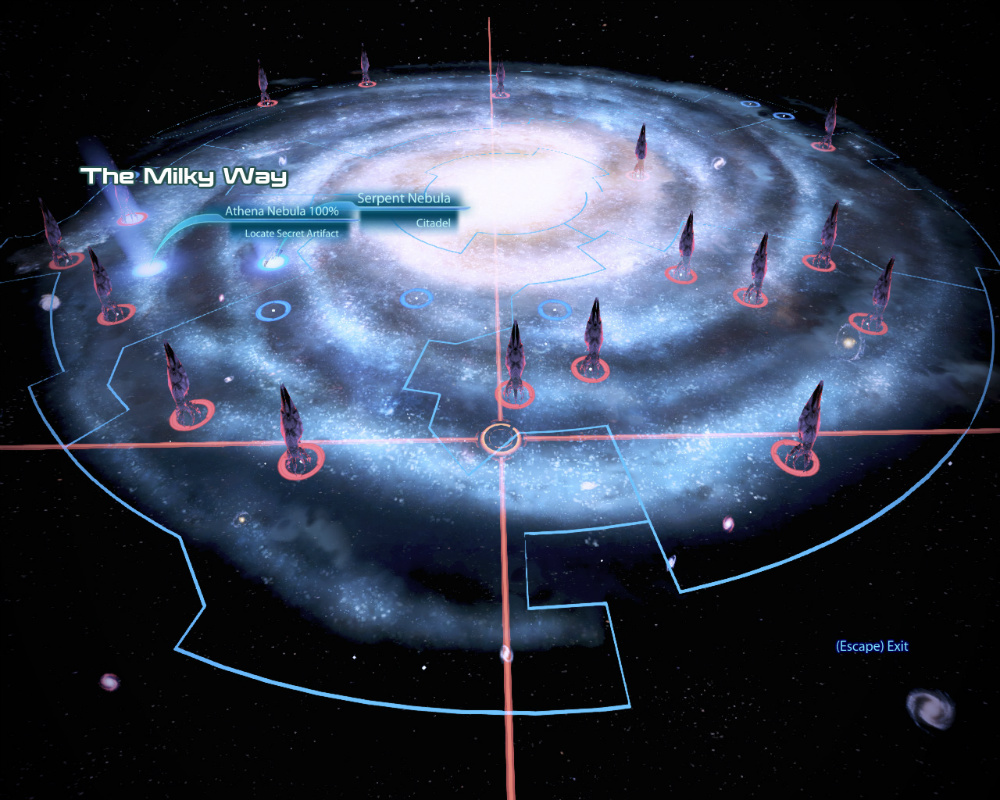
As an evolution from the original Mass Effect, Mass Effect 2 was astounding. Clunky combat and menu systems were streamlined, and the game was pretty much as polished as it could be. So it’s little wonder that, while Mass Effect 3 definitely improves on its predecessor, it’s not as big a leap forward as the previous sequel. But the important thing is that it does improve. Tedious mechanics like planet scanning are minimised to their bare essentials, movement is slicker as Shepard can now roll, make prompted jumps across gabs and climb ladders, and the Galaxy Map is easier to navigate (with an added threat of Reapers chasing your miniaturised Normandy).

But not every change works as well. Side missions are given to you awkwardly, as you overhear conversations on the Citadel (essentially a galactic Hub) and then dispatch yourself to solve these people’s problems. It’s a little like hearing someone in the street say they fancy a sandwich, and then you decide to return in a week with a sandwich for them. It’s awkward, and they feel a little pointless in the grand scheme of things, despite the fact that you gain War Assets for these little detours.

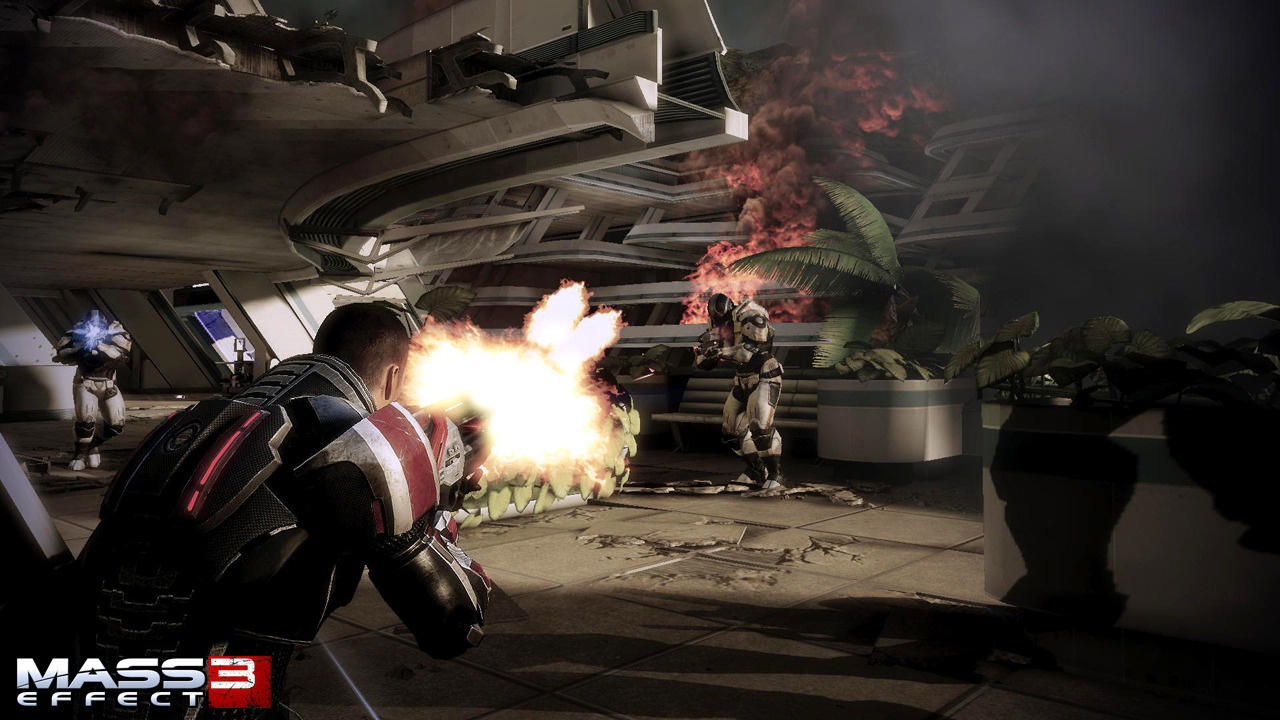
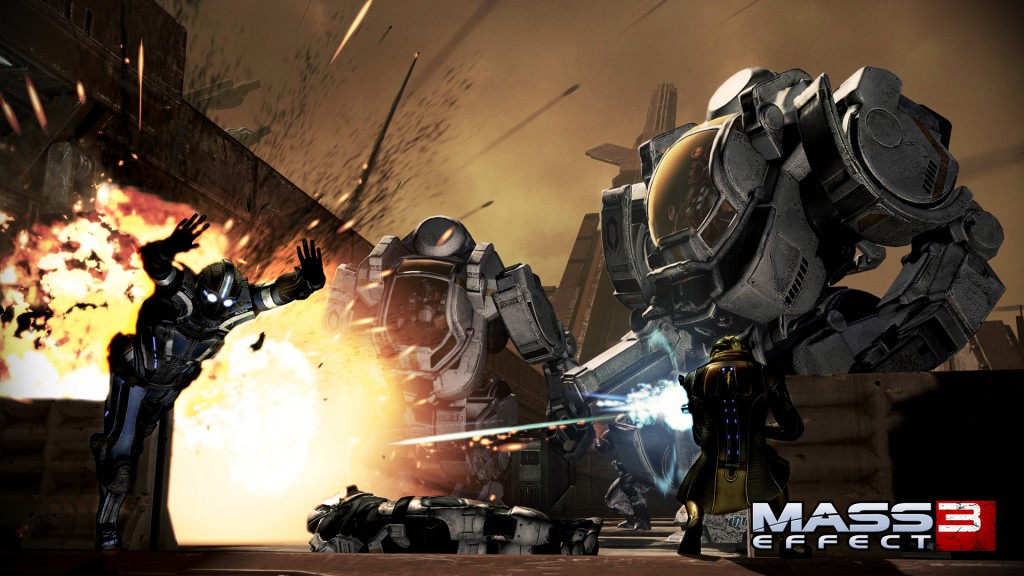
It’s a good job then that the main story missions work so well. Each one feels relevant and worthy of the time of the galaxy’s saviour. The conversation and choice system works the best it ever has, and your choices feel like they have a genuine impact in determining the fates of entire species. Combat is also mildly improved over Mass Effect 2. The cover-based third person shooting feels fast and fluid, with the game’s Powers system bringing an excellent balance and some stunning effects. The addition of a heavy melee (which differs for each class) also brings a different, welcome aspect to fights.

The AI of your squad works well, and they are often useful in fights, only going down if you aren’t paying enough attention to them. The enemy AI also provides a great challenge. They won’t just stick to cover and pop up like Whack-A-Moles, they will throw grenades, attempt to flank, and generally try their best to kill you. There are a variety of different types of enemies and each one requires a different set of tactics, which keeps the gameplay feeling fresh on your umpteenth playthrough.

Now, as this review is being written because of the Extended Cut DLC, I should mention the endings (spoiler-free). I was one of the people unhappy with the game’s original endings. I thought they were full of plot-holes, were very vague, and were just generally unsatisfying for someone who has invested 5 years and between 20-30 combined playthroughs of all three games. But with the addition of this DLC, I no longer feel like I’ve wasted my love on this franchise. Each ending feels satisfying and any previous inaccuracies are explained away well. I sat through my ending with a grin on my face the entire way through. That says a lot when I was previously so disappointed.

Despite being a story-and-character-driven game, Bioware decided to include a multiplayer component to Mass Effect 3. It could very easily have gone wrong, but thankfully it works amazingly well. Each match gives you Galactic Readiness to use in your single-player game and being able to play as each of the galaxy’s races is a treat. You haven’t played Mass Effect 3 until you have head-butted a Brute to death as a Krogan. Combine the excellent gameplay with Bioware’s continued free updates, and this becomes a multiplayer mode I will gladly sink many more hours into.


Fans of the series play Mass Effect for the story, for the characters, and for the fascinating universe that Bioware has created. Mass Effect 3 does not disappoint. It’s a thrill to play and is a world I will continue to engross myself in for many years to come. If you haven’t given this excellent franchise a shot yet, do yourself a favour and pick it up.


Developer: Bioware
Publisher: Electronic Arts
Platforms: PS3, Xbox 360 (Reviewed), Windows, Wii U
Genre: Action RPG/FPS
Release Date: 15 June 2012
Price: £39.99/$69.99

By Paul Brown

Friday, 13 July 2012

Game Review: Mutant Mudds


Mutant Mudds brings us back to the old-school retro style look, and it's a game that should be played by all seasoned players! This one was supposed to be released as a retail title on Nintendo DS as Maximilian and the Rise of the Mutant Mudds, but sadly, that didn't happen. The project was then moved to Nintendo's DSiWare service, but ended up not going there either. The game eventually found a home on the Nintendo eShop and PC, under its current name today. It's been a long time coming, but it has been worth the wait!


This game is developed by Renegade Kid, the team that worked on popular games such as Dementium and Moon for the Nintendo DS, and is lead by Jools Watsham. Mutant Mudds is an old-school platformer, where your objective is to eliminate the invasion of Mutant Mudds that have landed on Earth!


The player controls Max. Max is equipped with a jet pack, allowing him to hover across areas he can't do by just jumping alone (which is very similar to Gargoyle's Quest on the Game Boy). Also equipped is a water cannon to help eliminate enemies. There are 40 levels spanning across 5 worlds in the game, which includes main, secret and boss levels. Each main level has 100 jewels, and a water sprite in all levels to collect. Mutant Mudds difficulty is harder than first expected. The level design is done extremely well, and the environment of the enemy's moves takes a while to get used to. There are warp panels that allows Max to further away or closer towards you, which may alert some players like myself of where you are and where you're actually going (believe me, I got tricked at a couple points near the end of a level because I thought I was touching the water sprite, but really wasn't!). Also, each level has to be done on a time limit, which may put some pressure on players to get everything in that level. Each level has a secret area, which is marked either G-Land or V-Land. These secret level doors actually has an influence to the Game Boy and Virtual Boy. Fortunately, when you enter these secret doors, the time resets. If you die in these secret areas you immediately go right back to the beginning of it without having to start at the beginning of the main level itself. In terms of collecting things, you only need to collect the water sprite itself. However, that doesn't mean you will go without a challenge, as the secret areas may be harder than the main areas, bringing veteran players to the test.


Mutant Mudds has great usage of the 3D feature, with at least three layers put into it. The 3D fits quite well with the colourful, retro layout. Another thing that gave me quite the appreciation is the chiptune music, which is an added bonus! Going to the game over screen a lot of times usually is frustrating, however with this one, the music really touches my heart and is one of the most memorable tunes I've heard in a long time!


If there is any complaints about Mutant Mudds I have, it's the lack of items and objects. There is only three available right now, which is not much. If it had a variety of weapons and/or objects of such like in the Mega Man games, then players would have the ability to pick the weapon of their choice.


Conclusion


Renegade Kid has made Mutant Mudds is a game that can't be missed. It's clever level design and its difficulty makes this a must download purchase. Although, the initial game is fairly short, there will be extra levels added soon. If you're a fan of these types of games, or someone who is looking for something new to play, go download this now and experience this terrific retro-style platformer!


Publisher: Renegade Kid
Developer: Renegade Kid
Genre: Platformer
Platform: 3DS eShop (Reviewed), PC
Players: 1
Release Date: 21st June 2012
Price: £8.00/$8.99


By Vernon Schieck

Thursday, 12 July 2012

Game Review: Limbo


When I first started to play Limbo I wasn't sure what to expect. Reputed to be one of the best and most commercially successful indie games of all time, it had a lot to live up to. Vaguely aware of the game's art style due to stills on gaming websites, I loaded it up, but was completely unprepared for the game that came up before me. Because what stills of the game and reviews fail to encapsulate, is how much of the appeal and experience of Limbo lies in the atmosphere created by the animation and sound (or lack thereof). On the surface, Limbo is standard platformer, pretty much as simple as they come. There is nothing in the way of story within the game itself; Playdead only gave the game the tagline: Unsure of his sister’s fate, a boy enters the unknown. But it is this simplicity and ambiguity wherein lies the genius of Limbo.

On starting a new game the screen transitions from black to a dark forest in which the boy lies. The graphics are in greyscale, images in the forefront and background are out of focus, only the playable area is sharp. The screen flickers like an old black and white movie but nothing happens. I waited for my player to move, or for some indication that the game had begun, but until I pressed one of the arrow keys, the boy remained flat on his back. Upon hitting the key, the boy's eyes light up and he slowly got to his feet before waiting again for my command. This was the first indication that Limbo was not the usual spoon feeding game, that would offer instructions and hints in order to help the player solve a puzzle. The game required the player from the first instance to be proactive and learn how to control the boy themselves.


The boy's first challenge is climbing off of a tree trunk. It is completely simple, requiring only that he drops or jumps down close to the edge so he lands safely on the sloping ground below. From the top of the tree trunk it is impossible to see the ground and requires the boy to make a leap of faith. If the boy takes a running jump off of the trunk he will fall to his death, teaching the player early on in the game that being overly confident and taking action without thinking will get them nowhere. The player continues with care and trepidation, adding to the tense atmosphere instilled by the soundtrack.


It is difficult to underestimate how eerie a game without sound can be. The sound of footsteps, the rustle of trees, the crack of bones:  this is Limbo's soundtrack, at least in the earlier stages of the game. The distinct absence of sound in the initial stages, makes the louder sounds in the later levels all the more significant. The violent snap of the animal traps sent me flying about a foot in the air and shocked my system with adrenaline.


By now, the reader has probably sensed a strong sense of fear from this reviewer. This is due to the fact that (bear in mind I am a massive fan of the survival horror genre) Limbo is the most terrifying game I have ever played. The boy stumbles across dead bodies in cages, floating in pools of water and littered on the ground.  Seeing the spider creep silently behind you as you run away is far more affecting than any overproduced megaboss with frantic music of a Triple A title along the lines of the Legend of Zelda, Metroid and selected bosses of the Metal Gear series. The other boy figures who attack the player with dart guns and swinging traps make the outdoor area feel like Lord of the Flies without the cheery beginning, giving the game very sinister overtones.

The boy never gains any skills or power-ups, in this way the gameplay is very pure. Like other popular indie title Super Meat Boy, the difficulty of the game increases as new mechanics are introduced in each level. The boy must learn to time jumps, destroy body-possessing brain slugs and use anti-gravity switches in order to progress.  There are stages in which the whole level move and rotates (once in semi-darkness) which require great concentration on the players part, other levels which require different switches to be pressed quickly in order for the boy to reach the next level. The gameplay is innovative and the controls easy to use, with only two buttons: jump and action. Taking everything back to basics  allows Limbo to offer something original and atmospheric. The game doesn't last very long, you will finish it in a couple of hours, but if you are looking for something a little bit different and whole lot of dark I urge you to give Limbo a look.


Developer: Playdead
Publisher: Microsoft Studios, Playdead
Platforms: XBLA, PSN, Windows, Mac OSX, Linux
Release Date: 21st July 2010
Players: 1
Price: £6.99


By Emma-Lee Davidson

Tuesday, 10 July 2012

Game Review: Serious Sam HD: The Second Encounter

A welcome less-'Serious' & over the top shooter in the age of gritty realism: 


In "The First Encounter" Sam "Serious" Stone had to battle his way through vast hordes of enemies to prevent alien races from taking over the universe. As this is a direct continuation the story follows the same path however so does the gameplay.

Largely "The Second Encounter" is exactly like the first in the series just with a new environment and a couple of extra weapons and enemies so going into the game thinking there will be a whole lot more will leave you disappointed. I however was expecting exactly what I got and it definitely was not a bad thing.

The game starts with Sam crash landing in South America, conveniently close to the object he is now trying to obtain. The player is stripped of all weaponry collected in the first game which makes sense seeing as there will be players who start with this game and it is the beginning of a new part of the story. What didn't make sense to me was how the game reintroduced about half the arsenal within the first couple of stages along with three new weapons. 
Although the armoury felt more complete with a chainsaw, flame-thrower and sniper rifle to use, the pacing that the game used for their distribution felt rushed.

As ever Serious Sam does not hold back and throws everything it can at you right from the off however within the opening minutes you'll be facing enemies which weren't introduced until much later in the first game. This may be the reasoning behind including so many weapons in the very early stages of the game but it may be a little overwhelming to newcomers. With those two points out the way, alongside the old enemies are an array of new ones including chainsaw pumpkin men, alien soldiers and winged demons. This new cast of cretins adds a small but welcome variety to the enemy ranks waiting to get blown to pieces.


There are three scenarios throughout the game, South America, Persia and Medieval. Each has a unique look and different level layouts which is a lovely contrast to playing through a mostly yellow coloured campaign in the shape of Egypt from the first game.

An annoying feature is that you lose all collected weaponry at the beginning of each scenario, not just the first one. And each time you are quickly re-introduced to the lovely collection you had to leave behind. Again, it makes little sense to me.

In terms of core gameplay, it is largely the same as the first game but with different level structures. Puzzles are still no more complex than "find button, push button, kill an army equivalent to the population of the Earth and continue" but the game uses them well. The boss encounters are a lot more exciting than simply fighting another horde of enemies as this time three main bosses are included, one for the end of each scenario. Although they largely follow the same structure in terms of how to kill them, it felt good to have a finale style battle.

In terms of multiplayer, "The Second Encounter" includes a co-op mode and a death-match mode, which return from the first game, as well as a new survival mode. I managed to play all three this time around, if only for a short while however, I did gain an opinion on all three.

The cooperative model is the one people have hyped up for me. It allows for up to 16 players to battle side by side through the games campaign missions with unlimited re-spawns and what I visualised as full-on carnage. Sadly, I was disappointed. I paired up with around 5 others and played through a level midway through the game however with the firepower of 6 people it was ridiculously easy, let alone 16. I can see how people may find a thrill to having that many people play at one time against a mass onslaught however winning isn't fun if it's too easy and there is practically no way to lose.

There is a version of the co-op campaign which limits the team to three lives per level which means players actually have to be careful. This provides a much more tense and fun experience in my opinion.

The deathmatch mode was fun from what I played however I got booted from every game for playing the game as it's meant to be played; get kills, don't die. That aside, the arenas were nicely designed and the "Quake" style of play worked well.
There are several other game modes however deathmatch was the only one with players.


The last mode, survival, was the most fun I had outside the solo campaign. It is very similar to Horde mode from the Gears series or the Firefight mode from the Halo series however instead of multiple waves there is one never-ending one with timed enemy spawns. It was great fun to play, shooting everything in sight until you simply couldn't hold them back anymore. After you die, your time of death is logged and counts as your score. This provides a contrast to the L4D survival in which team time is awarded.

Overall I enjoyed the multiplayer aspects of the game but I personally feel a greater sense of achievement if I beat something really difficult on my own and when there is a way to lose.
I can imagine playing all of the different modes would be fantastic if playing with people you know as it always adds a greater element of fun than playing with or against random people.


Although it has flaws, "Serious Sam HD: The Second Encounter" was ab enjoyable experience. I'd have to recommend it over "The First Encounter" as it's practically the same game with simply more stuff added. The new enemies, weapons, power-ups and some truly wonderful secrets compliment the new campaigns to provide an intense, full-on old school fps.
For those who played the originals, you already know what the games are like, however, if you didn't get a chance to play it back in the day (like myself), give this remake a go. You may be pleasantly surprised.


Developer: Croteam
Publisher: Devolver Digital & CDV Software Entertainment 
Platforms: Steam (reviewed) & Xbox 360 Arcade
Genre: FPS
Release Date: 28 April 2010
Price: £6.99 / 1200 MS Points


-Tom Seed

Game Review: Lollipop Chainsaw

Attractive girls can kill zombies too...


Lollipop Chainsaw has been surrounded by controversy. It has been accused from many corners of objectifying women, perpetuating stereotypes and being downright crude. But what all of the publicity has tended to leave in the dark is - it's a pretty average game. The opening cinematic plays out like a nineties chick flick along the same lines as Clueless and heroine Juliet is equally as vapid as the film's Cher. The melange of the undead and high school drama isn't exactly original but provides the foundation for a story which is at times genuinely witty and entertaining, despite its self-conscious ridiculousness.


Juliet Starling is a chainsaw-wielding, cheer leading, scantily clad, blonde bombshell, whose ditsy dialogue often invokes eye-rolling and the occasional chuckle. As she fights her way across her hometown she is accompanied by boyfriend, who thanks to an unfortunate zombie-biting incident at the beginning of the game, is now a decapitated but animate head.

Comic book style animation and stills combined with a cel-shaded colourful approach provide Chainsaw with a fresh, endearing look which combines perfectly with the light-hearted comedy which is at the heart of the game. It is a shame that so much of the animation is dedicated to Juliet in compromising positions; never a cut scene goes by without an up skirt shot, which is ironic given that an achievement is awarded for managing this in-game. Unfortunately, this does not even scratch the surface of the misogynistic behaviour that Juliet is subjected too. She is frequently called a 'whore' or 'bitch' and one of her classmates tells her he will 'totally masturbate to you tonight'.


The controls are your basic hack and slash. Juliet has a pom-pom stunning attack as well as her basic chainsaw move. I often found the controls to be sluggish and at times even unresponsive. The combo moves are simple button combinations but only a couple seem to hit consistently. After gaining enough meter Juliet can unleash her super mode which allows her to take out zombies in one hit while 'Hey Mickey' plays in the background - CAUTION: you will know most of the words by the end of the game if you don't already. Juliet gains other super moves throughout the rest of the game, involved propelling Nick out of a cannon and gaining a super blaster projectile weapon which is probably the most accurate weapon. Juliet does a dance after racking up some combo kills which leaves her vulnerable to attack, which can be very irritating and damaging if she is in the middle of a group of zombies.


There is little in the way of original features on offer in Chainsaw. Some of the stages have some quirky features, such as the hallucinogenic farm area which allows you to plough through a field of zombies on a combine harvester and the Funland stage which features Pacman and Pong influenced levels.

If the tiny outfits, misogynist comments and dodgy controls haven't put you off yet, it is purely because of the humour. While Juliet's remarks often fall flat ('you're like a kitten, a kitten that doesn't speak Japanese') her boyfriend's banter is what keeps the comedy in the game. With gems such as 'This is so much fun, I almost forgot all my friends are dead!'. However, the main problem with Chainsaw, is that the line between satire and filth is constantly blurred. What begins as an ironic poke at American culture quickly becomes an excuse to objectify Juliet in every way possible, leaving an uncomfortable aftertaste. Some of the worst moments include Juliet revealing her aged Sensei taught her how to pole dance and gave her some 'sweet lap dancing moves'.

While the controls are temperamental and the behaviour towards Juliet outrageous, Lollipop Chainsaw offers some entertainment. Juliet is far from an engaging protagonist but Nick and family go a little way in making up for that. If you can look past the often distasteful but sometimes witty jokes and see the game for what it is - a bit of fun - Lollipop Chainsaw is a reasonable way to spend a couple of hours and empty your head.


Developer: Kurukowa Games/Grasshopper Manufacture
Publisher: Warner Bros. Home Entertainment Inc.
Platforms: PS3 & Xbox 360
Genre: Hack & Slash/Horror
Release Date: 15 June 2012
Price: £29.99/$59.99

By Emma-Lee Davidson

Monday, 9 July 2012

Game Review: Family Tennis 3D

Family Tennis 3DS eShop Review


ARC System Works recently brought its first 3D entry of the Family Series to the Nintendo 3DS eShop. The Family series first appeared on WiiWare, but they were just average or below par than what 3DS gamers had hoped. However, this title follows a whole new format so read on to see how this one did:


Family Tennis 3D brings us those same familiar characters that we saw in the other Family games. In terms of game modes, there is: Quick play and game play. Quick play throws you into a quick casual match against an opponent randomly chosen, and set usually at two games, one set matches. This mode is a good way for you to get used to the game. In game play, you have the option of choosing either free play, tournament, and minigames. Free play allows you to select singles and doubles, as well as the characters and the option or how long you want your game to be. Tournament mode provides you a series of matches on the difficulty of choice. You can only select higher difficulties if you completed tournament on the lower ones. Finally, minigames allows you to pick between three different options that has an objective of trying to get a higher score than your opponent. In terms of other features, unfortunately there is no multiplayer, which will probably set other players, along with myself disappointed there is none of that in this Family series entry.


The games controls allow the usage of the circle pad to move your character. It's a shame there is no option to use both the d-pad and circle pad. Additionally, the movement is wonky at times, making it difficult running to get the ball and hitting it. It seems you character dives down almost every time you do both actions almost or entirely at the same time. Also, some of those opportunities to do a smash hit sometimes goes over the area mark, making these efforts frustrating at some of these moments.
The 3D capabilities are at least decent, but do not exceed what I was expecting. It is not terrible by any means, but the developer could have added more more layer or depth to the game. The animations are good though, and the additions of viewing replays after every score, as well as the ability to change camera views are welcome additions.


Conclusion
Family Tennis 3D at the core is a passable tennis title, but does not rise to the quality tennis fans would hope for. The game's often poor controls and lack of controller options makes me difficult to recommend this game to 3DS owners. There is an option to set it to easy mode, but unfortunately it doesn't make much of a difference. Unless you are a huge fan of all of ARC System Works past games in the Family series, it's best shy away from this title and to just save your cash something such as Mario Tennis Open for your portable tennis fix.


Developer: Arc System Works
Publisher: Arc System Works
Platforms: 3DS eShop 
Genre: Sports
North America Date: 5th July 2012 / 
Europe & UK Date: TBA
Price: $6.99


- Vernon Schieck

Tuesday, 3 July 2012

Game Review: Trials Evolution

 One of XBLA's most popular series is back...


The Xbox Live Arcade network has been getting some pretty good titles these days. It's nice to see developers being able to come up with some really fantastic games that we don't need to wait yonks for, (though not in all cases- Fez, 5 years?!) and for a reasonable price that doesn't burn a hole in your wallet like the price of your standard retail disc. Of course, as with any games platform, there are still plenty of flops in the Xbox Live Arcade library, but I think the recent gems that have shone through the grime of half-assed productions and sea of paper thin Indie games is a sweet treasure to behold. If I were a pirate, as in a sea pirate, I'd tell you that X(BLA) marks the spot for some incredibly entertaining, original and modestly priced games!


One such game that sparkles brightly in the newest additions to the XBLA platform is Trials Evolution. If you ever played its predecessor, Trials HD, I can tell you Trials Evolution quite simply has everything great about that game and more. Much, much more! The premise, for those unfamiliar, is simple: You ride a motorcycle in a series of different maps and have to make your way from start to finish as quickly as possible in one piece. The physics engine is the most crucial element to this, as you find yourself carefully balancing and tweaking your rider's position in order to traverse the many objects that will be in your path. Starting off with something as simple as a set of barrels and escalating up to near-vertical ramps and jumps between platforms that Mario would have a difficult job handling. It's a hard game. Oh yes. In similar vein to Super Meat Boy, it'll take some real skill to get through some of the more difficult levels and will most likely have you cursing wildly and pulling your hair out, but it's so awesomely addictive that it'll have you coming back for more every time. And when you do win, it feels great.


The single player mode starts you off with a tutorial telling you the basics and shoves you off from there, giving plenty of unique and exciting maps for you to better your technique in, before bumping up the difficulty and giving you a few new tips on overcoming the more challenging levels. At these milestones in your career, you'll also unlock new bikes that will let you go faster and be more agile than before, allowing for fast and frantic action speeding through the levels and also the careful precision required to beat the wonderfully crafted areas. You can also use these new bikes to play with online against other riders and beat your times in previous levels. There a 4 medals for each level. Bronze, Silver, Gold and Platinum, though the fourth is only an option when you complete most of the career. The better the medals you get, the quicker you can unlock new levels and experience grinding new joys and difficulties. The leaderboards are really a great part of the element that are brought up practically everywhere in the game, rather than just some option to look at off in the menus. Every level has the score board show your friend's best times, adding the element of competition that makes this game work so well.


Multiplayer is also rather good. Online, you can play supercross, trials or hardcore trials events with friends or strangers. Supercross is a racing mode that has up to four players on the screen at once in a frenetic battle to the chequered flag at the end. Trials is basically the single player mode, but still racing against other people, though it's just their ghosts. And hardcore trials is the same as the latter, though with the most difficult levels of the game playable. And they certainly are difficult. You can rank up in multiplayer also, but after you unlock Hardcore Trials, it's mostly just a number to represent your skill/time put into playing online.


Remember the golden days of building your own dream park in Tony Hawk's games? Well, Trials Evolution has its very own Track Editor. Though, when I say track editor, what I really mean is an absolutely mind blowing construction kit that lets you use the same tools as the developers to make your own levels. I haven't seen anything quite so advanced that's directly integrated in the game and allows for such incredible maps to be made except maybe the Elder Scrolls Development kits. It allows for anyone to try their hand at making some really great stuff, which has already been showcased online.


Track Central allows you to download other people's tracks made in the editor and try to get your own high score on it. Some of the maps we've seen on it already are pretty spectacular and we're still only a short time away from the game's release. It's even possible to make games that don't even have you doing trials at all. The developers themselves have shown how versatile the kit is by showing levels that mimic games such as Angry Birds or Marble Blast. There's even some first person scenarios where you have to find objects, or shoot targets.  The community has already caught onto making some really good trials and skill games along these lines and the results have been nothing short of fantastic so far. The editor adds a huge amount of longevity to the game, with new maps coming out every day. It's certainly a strong excuse in buying the game alone.


Trials Evolution is a fantastic game that, if you have the patience to play is absolutely worth playing. For the great addictive gameplay, the fun multiplayer and leaderboards competition and the stunning map editor and the hundreds of creations it has spawned. It's time to get some high scores.


- Andy Robison

Sunday, 1 July 2012

Game Review: The Amazing Spider-Man

The Amazing Spider Man Review

Developer: Beenox
Publisher: Activision
Platforms: Xbox 360 (reviewed), PlayStation 3, Wii, 3DS, DS, Android & iOS
Genre: Action/Adventure
Release Date: 29/06/2012
RRP: £39.99/$59.99


I’m going to get this out of the way straight away. I am a massive Spidey fan. This undoubtedly makes me biased in this review but, let’s be honest, if you aren’t a fan of the character then you are not likely to give this game even a second glance.

The Amazing Spider-Man is a movie tie-in game, but it has its own original story. Set only a short time after the events of the film, the plot sees Spidey accidentally become the cause of the release of a virus that threatens to turn all of Manhattan into human/animal hybrids, like the Lizard. Let’s be clear, the first hour gives away the majority of what happens in the film. This isn’t a big deal if you know the comics fairly well, but if The Amazing Spider-Man is your introduction to the Webhead, prepare to be spoilt on the fates of a number of characters. The plot is decent enough, it’s nothing special, but gets the job done (some “twists” are extremely easy to see coming) and provides you with plenty of situations to kick some ass. The game is an excellent length. Completing everything except the collectibles gave me a total game time of around 11 hours, which is surprisingly long for a movie tie-in.

The film’s cast did not lend their voices to their respective roles, but their stand-ins do an excellent job. Each actor is solid, and the writing does each character justice, with Spidey happily getting some excellent one liners.

The developer, Beenox, knows him. This is their third title with the character and they have him down to pat. Movement through the open world of New York looks incredible. Spidey does flips, spins and performs suitably acrobatic dives while web swinging through the city. But it’s the addition of Web Rush that makes you truly Spider-Man. By pressing RB, the player can select a point and Spidey will automatically move to it. He will run along edges, catapult himself off flagpoles and bounce of the side of buildings to reach the point, all of which looks amazing. Each animation is smooth and elegant and the transitions between them are unnoticeable. This should be the defining mechanic for a Spider-Man game, and I for one will be extremely unhappy if it is removed in future titles.

Combat is almost as smooth as travel. The game borrows its combat system from the Arkham series of Batman games, with players having access to the X button for attacking, the Y button for a reversal when Spidey-Sense goes off, and the B button doubling as a Web Shot, and allowing you to perform a Signature Move when an enemy is stunned (which is essentially a finisher). It works well enough, with Spider-Man moving fairly fluidly between enemies, but sometimes suffers from its simplicity.

You can also choose to take out enemies from the shadows, with Stealth Takedowns from the roof. These can get a little tricky when the camera decides not to play ball with you however, and caused me to reveal myself to enemies multiple times. This problem is especially prevalent in the indoor sections of the game.


Unfortunately, there are a lot of indoor missions, with each main story mission taking place inside. Most of Shattered Dimensions, and all of Edge of Time (Beenox’s previous two Spider-Man titles), were set inside, so it’s clear that Beenox knows how to deal with a confined Spider-Man. It would just help if the camera worked a little better when you are on a roof.

When back outside in the city however, the camera works perfectly. It sticks closely to Spidey, the screen blurs as you fly past buildings, giving you a suitable sense of speed, and it is accurate enough to allow you to leap from point to point without worrying about where you are going to end up. This definitely helps for the collectibles, of which there are a lot of. This will be a tough game for completionists as there are 700 comic book pages scattered throughout the city. These pages become actual comic books that you can read in the menu, which is an excellent addition, giving you the first appearances of the game’s villains, as well as one more modern Lizard story. Besides these pages however, are a number of other collectibles to be found in each of the main missions (all of which are replayable). All in all, there are around 900 collectibles to be found, so if you’re an OCD collectathon gamer, you have a lot of work on your hands. By the end of my playthrough, I only had around half of the collectibles, and I was actually looking for them.

There are also a number of alternate costumes to be unlocked for fans of the character. Unfortunately, these are neither as numerous or as interesting as in Shattered Dimensions or Edge of Time, but it is still a nice touch. Each costume looks incredible however, and a huge amount of detail has been put in each one, as they get more and more tattered as you take damage. Coming out of a mission you found challenging looking like hell is an excellent touch.

The game can get a little repetitive. Side missions like transporting infected civilians to quarantine are filled with repeated dialogue and can get a little tedious. Car chases always end in an awesome way, but it’s still the same way. It’s repetitive, but still manages to end up being damn fun.

The Amazing Spider-Man is a game for Spider-Man fans. It’s filled with memorable moments (battles with Hunters can literally span the entire city) and subtle nods to potential future villains, and while there are a few flaws, screw ‘em, I’m Spider-Man.


- Paul Brown

Twitter Delicious Facebook Digg Stumbleupon Favorites More
KingViral
See my work in Kettle Mag