Rayman Origins Review
- Publisher: Ubisoft
- Developer: Ubisoft Montpellier
- Platforms: 3DS, PS3, PC, PS Vita, Wii & Xbox 360
- Genres: Platformer
- Players: 1-4
- Release Date: November 2012 (PS3, Xbox 360 & Wii)
- Price: £14.99+/$19.99+
You know, at times it’s a curious thing being a classic gamer. I get a little excited any time a game is announced that opts to nix the third dimension - it is, after all, a pretty uncommon event these days. I’ll admit to you that it doesn't generally matter what the game is, either; if it takes place on a 2D plane, it’s got my full attention. So while I fancy myself some kind of gaming purist (retro-whore is probably more accurate), in truth it’s a very rare game indeed that manages to blow me away completely. Rayman Origins is that game.

Now, Rayman Origins is a whole lot of things, but one thing it’s not is anything new. If you’ve played a 16-bit platformer, you’re going to feel right at home. You run, you jump (and shoot), and that’s it. You do this for 60-odd levels. Sounds like an exercise in repetition, but the genius of the design ensures your experience is anything but. The game plays like a mix of the best elements from Genesis classics Sonic the Hedgehog and Dynamite Headdy, a little bit of Super Mario Bros., and “the other SMB”, Super Meat Boy. I don’t intend to make it sound derivative, but rather emphasize the kind of pedigree we’re dealing with here.
Rayman can walk, run, punch in the four cardinal directions, shrink (altering attack properties), catch ledges, bounce, float, swing, run along walls or ceilings, swim, and even pilot a giant mosquito. By the latter half of the game, you’ll be utilizing all of his abilities to make it to
the end of each stage. If that all sounds overwhelming, rest assured it couldn’t be simpler – the entire game is played with two face buttons (for jump and punch), with the right shoulder buttons dedicated to running, which keeps your thumb from working too hard. With a smooth difficulty curve, you’ll be mastering all of Rayman’s abilities in no time. And it’s a good thing too, because this game is no pushover.
Rayman Origins is a tough little platformer, but unlike the aforementioned Super Meat Boy, its goal is not to be a grueling test of skill and reaction time, but rather a game of options. This is where the sheer brilliance of the level design really becomes apparent, as the layout of each and every stage can be tackled in a variety of ways. While it’s relatively easy to just blow through the game, if you want to master all of its challenges, be prepared to muster all of your platforming skill.

You have a number of basic goals beyond reaching the finish line: There are Lums to collect (the game’s version of coins or rings – if you’re looking to master the game, you’ll want to finish each stage with 350 Lums or more), secret cages to find and times speed runs to beat if you expect to see everything Rayman Origins offers. The time challenges (and special chase stages) in particular are sheer genius and truly showcase the meticulous attention to detail Rayman’s level designers brought to the table. These stages are all about momentum, route planning and precision jumps and attacks, and represent some of the finest platforming sequences I’ve ever experienced. Bring your A-game if you want to complete this one 100% - and trust me when I say your efforts aren’t in vain, as you’ll need to earn enough badges to access the ten treasure chase levels, which in turn will earn you the ten “Skull Teeth”. Collecting all the teeth unlocks the game’s true final level (and boss). The treasure chase and final stage (“Land of the Livid Dead”) are the highlights of Rayman Origins, so while they’re optional, please consider them mandatory. You won’t regret it.
As if the rock-solid platforming weren’t enough, Rayman Origins masquerades as a shooter from time to time. One of the most pleasant surprises in the early game for me was when I first hopped onto my little mosquito buddy to jet over to the next island. Scrolling shooters (Shmups) are my favourite kind of game so it was a real treat to see another homage to a marginalized (nigh extinct) genre that was once the king of the arcades. While the shooting stages don’t hold up to the best examples in the genre, they break up the action nicely and show, once again, just how brilliant the stage designers are; none of the shooting stages are particularly difficult, but memorization, aim and precision movements are going to be required if you expect to collect enough Lums to nab all the medals. The team responsible for the shooting sections clearly understand the appeal of these games and it shows when you aim for the best possible score by the level’s end.

Boss fights, while sparse (five platforming bosses, two shooting bosses), are all unique, challenging and utterly hilarious. I don’t want to ruin anything here so I’m going to keep things vague but if you've ever dreamt of fighting the horrors of acid reflux in a very literal sense, Rayman Origins has you covered.
As if this just wasn’t enough for Ubisoft and brainchild Michel Ancel, the entire game is playable with up to three other friends (offline only) at the same time. While it won’t be the preferred way to achieve your best times and scores, you’d be crazy to avoid the slap-tastic mayhem playing with friends offers. There are benefits to cooperating, as friends can help you obtain some of the difficult to reach jumbo coins found in each stage, but it’s so much fun slapping your friends around that you’ll be hard pressed to get anyone to settle down and coordinate. Of note, while this mechanic may appear to work much like the cooperative perks in games like Little Big Planet, co-op is not required to obtain all the goodies in the game. With about two-dozen characters to unlock (the vast majority simple re-skins of Rayman/Globox/Teensies), it’s generally very easy to keep track of who is whom on screen. Seriously, if playing with friends doesn’t put a huge goofy grin on your face, you may want to ensure you still have a heart.
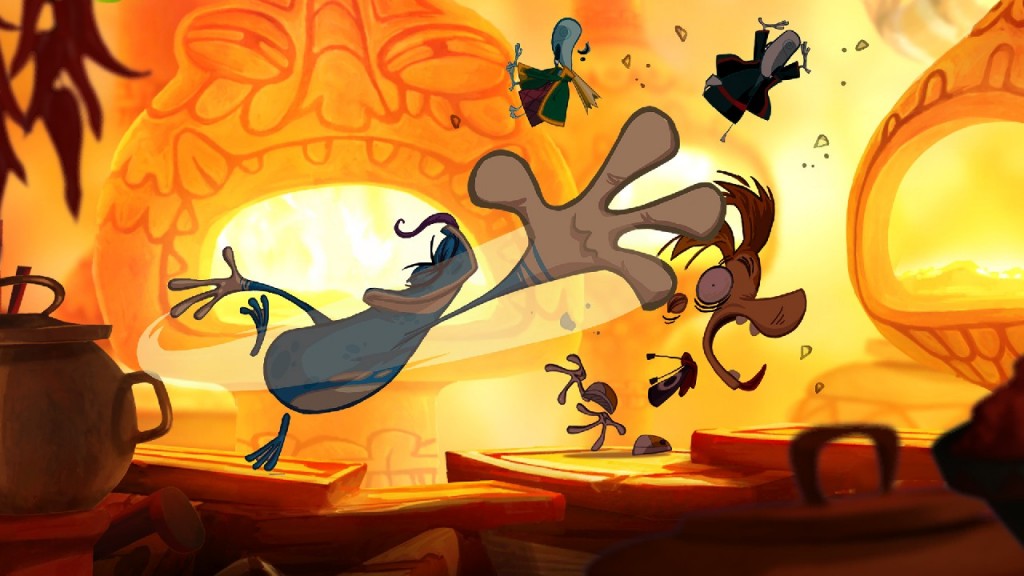
What should be obvious to anyone who’s seen screenshots or footage of the game, Rayman Origins is absolutely gorgeous. The completely hand-drawn artwork, simultaneously stunning and bizarre, is executed with as much care as the level designs and represents some of the most consistent art direction I’ve ever seen in a video game. This is a game that proves graphics can indeed make a game better. There are layers upon layers of parallax scrolling, plane changes, an incredible colour palette and crisp, detailed definition between objects and obstacles, all running at a consistent 60 frames per second, with no frame drops or slowdown, even with four players on screen. The UbiArt Framework (the game’s engine) is a technical marvel and deserving of accolades in its own right. While currently proprietary, industry reports indicate Michel Ancel is pushing to make the technology open-source. If he succeeds, all of us will benefit. Seriously folks, unless the Wii is your only means of playing this game, I beg you to purchase this one on PS3 or Xbox 360. Playing the game in standard definition would be a borderline tragedy.
What no screenshot will show you is just another dimension of the game that deserves mention -if not an entirely separate article: The soundtrack. As bizarre and beautiful as the visuals, Rayman Origins’ audio experience is absolutely sublime. Peppered with adorable, helium-infused vocals, the score is a masterful blend of Country, Big Band, Jazz, Hawaiian and Rock, if they all met up at their local auditorium backed with a full symphony. It’s whimsical-but-epic, glorious-but-understated. It brings me to my only noteworthy gripe: There is no sound test option. A score this exceptional stands on its own and it’s a shame it isn’t possible to enjoy the individual tracks without having to fire up the game and hop into a given level. Of course, when the gameplay is this much fun, it’s hard to sell that as anything but a superficial niggle.
Rayman Origins is a bonafide masterpiece. A package so loaded with content and so immaculately presented that I can’t help but gush over its sheer magnificence. Gameplay and controls have been honed to a razor’s edge. The stages present incredible variety, both in terms of level design and scenery, as well as methods for gamers to tackle the challenges. Multiplayer, collectibles and unlockables offer fantastic replay value, and the visual and audio designers have managed to elevate an expertly crafted game into a sublime orgy of platforming bliss.
Buy it, play it, love it. Rayman Origins is not only one of the best games released in 2011, but is perhaps the finest example of the Platformer genre ever created. I’m not willing to label anything as perfect, but this is as close as it gets.
- Ryan McLaren